Friday, May 1, 2009

Artist Statement: The Art of Experience

I have always lived two lives – one while I am awake, and the other, while I sleep. Dreams are a frontier all their own; they represent the landscape of our imagination, and are a gateway into our core selves. So often do I wake up from a dream, wanting to rush out of my bed to tell someone about the experience. Yet, something always gets lost in my description – my words always fall short. The one listening simply needs to have been there, seen the things I saw, and lived what I lived. So, I am drawn to pick up a ‘paintbrush’ - though, not one for painting images, but rather, for painting experiences.

My name is David Harrison Turpin, and I am a video game designer. My art is collaborative – not only in the sense that it requires the cooperation many in diverse fields, but also in that it calls for the participation of the consumer. Some might see this as a weakness of the medium; I view it as its strength. Rather than forcing my thoughts or emotions upon the consumer, I let him arrive there himself. I am the director of a world that, if designed with care, can bring him through a spiritual journey that reveals a great deal about himself, as it does about the artist.

I have things to say, and so my games are designed to speak. I believe that great art is communicative, thought provoking, and emotive, and I aim to design works that carry all of these qualities. I communicate chiefly through a language of choice and consequence, which enables players to experience my thematic influence while exploring the worlds of my games. The player derives meaning from my art not just by seeing or hearing, but by doing.

Adventure is my genre of choice, because I find it entertaining. I view entertainment as an inherent quality of good art; I believe it is the optimum of effective communication. My favorite films include The Empire Strikes Back, Indiana Jones, and The Matrix, and I admire them for their beautiful infusion of art with entertainment, a combination that has always fascinated me. For this reason, I am a proponent of the Postmodern filmic tendency to ‘collapse’ the realms of ‘high’ and ‘low’ culture. I desire to express myself to everyone, and to do that, I must meet them halfway; their time is as valuable as mine. I entice them not with the promise of art, but of adventure.

I am attracted to adventure also because it physicalizes a protagonist’s journey. It is concrete and immersive, and potentially highly expressive. Dreams are likewise powerful because they physicalize our deepest thoughts and emotions. The things that we love and cherish can be found in that worlds we visit every night. Sometimes, we see our inmost fears standing before us, waiting for our response. How we respond is what evolves the dream and progresses our journey. At night, we are all Artists of Experience; my hope is to become one during the day.

Friday, April 24, 2009

Raz: A Writing 340 Video Game

This semester, I had the privilege to work with ‘Team Blawesome’ as part of an assignment for USC’s writing course, “Advanced Writing for the Visual and Performing Arts.” The assignment was very open ended: the class was divided in teams of four, and each team must utilize the artistic strengths of each individual to collaborate on an artistic project – any artistic project –that can be presented to class. My group consisted of Allison, an actress, Brian, a film writer-director, Katherine, a graphic designer, and me, a game designer. The combination of these talents led us towards the creation of a story-driven video game. After a good deal of brainstorming, discussion, and hard work, we were able to produce a small demonstration for a game we have tentatively entitled Raz.


Raz is a 2D, side-scrolling, action-adventure game concept that follows the story of a sabertooth tiger cub whose mother goes missing. Now, he must lead his younger brother and sister across a vastly-changing terrain, which is being torn apart by seismic activity. Thus begins Raz’s journey to find his mother and lead his siblings to safety. It is an icy adventure across a prehistoric landscape.

As game designer, I set out to figure out what the player does, and how to make that activity fun. I first began with what I call “character-centric” game design. I asked myself, why would someone want to be Raz? What can he do? The obvious answers were that he can run, jump, and use his teeth and claws to attack. This merely suggested a kind of “Super Cat Bros.,” which did not sound very inspiring. It then occurred to me that the core gameplay might be summed up in two words: claws and ice.


The concreteness of these words began to spur images and emotions within me almost instantly. I began to see Raz clasping onto giant blocks of ice in a struggle to climb out of dangerous situations. The thought of having to choose when to slide and when to clasp while on ice seemed very intriguing, and it grounded my vision as I continued to make game design decisions. Thus, we now have gameplay that feels somewhat unique, allowing for the player to feel like a specific character that could not be Mario, a housecat, or even a modern-day tiger. Indeed, it seems that only a sabretooth could engage in this particular activity.


For me, this project provided some great practice in game design. I learned how to more efficiently isolate intriguing gameplay by first beginning with the character, and then asking myself why that character is unique. In a gameplay context, ‘unique’ refers to what a game element can do. In this way, my approach to Raz began with story elements (character, goals, and obstacles), from which I translated into gameplay, much in the way directors and cinematographers translate a screenplay into a motion picture. Working in this way, I was able to draw upon Brian's story concepts to engineer a product that could integrate Katherine's visual design as well as Allison's ability to provide dramatic voice acting (though, regretfully, we did not have time really flesh out the sound design). The approach I employed allowed us to blend story, art, drama, and gameplay quite seamlessly, and because of that I am very excited.

Wednesday, March 11, 2009

Watchmen: Film Review


Movies are emotional and powerful because they present us not only with philosophical issues, but also with characters that have to deal with those issues. These components might be said to derive from Aristotle’s Rhetoric, particularly in regards to the concepts of logos (logical reasoning) and pathos (the utilization of human emotion). In order to hit the audience with a powerful experience, movies must balance between both; tipping the scale it too much in favor of pathos can cause the movie to feel silly and overly dramatic, while tipping it too far towards logos can cause the film to become too cerebral and emotionally detached. I felt that Warner Bros.' recently-released superhero film, Watchmen (2009), suffered from the latter scenario. As a result, it engaged my mind, but not my heart, and although I finished the movie feeling like I had seen something amazing, I still thought, “What’s the point?”


Watchmen echoes certain Postmodern trends that are not typically exhibited in the superhero genre. Films like Pulp Fiction (1994), Election (1998), and American Beauty (1999), all present the audience with multiple characters that we are meant to observe from a distance. There is no singular protagonist in any of these films, and very few characters (if any) are presented as heroes. They all seem to carry elements of black comedy, placing audiences at a distance from the characters so that we may view all of them objectively, comparing each of their struggles, goals, and traits. Each film communicates a darkly comedic tone by addressing the audience directly, employing phenomena such as voiceovers and freeze frames to consistently remind the audience that they are watching a movie. Through this point-blank style, the film “allows” audience members to laugh at the implications of statutory rape in Election, and to snicker at the sodomization scene in Pulp Fiction. We are given a privileged vantage point of the bigger picture, and through this we are able to analyze the situation objectively. These types of films typically finish with a morally ambiguous ending, prompting audience members to objectively derive meaning from the events that unfold before them. It is in this way that these films, as well as Watchmen, exhibit thought-provoking logos.


Watchmen was successful in this pursuit; it got me thinking. It is a film about superheroes – not a specific superhero, mind you, but all superheroes. It is about America’s fascination with superheroes. It is about the superhero myth and legacy, and what it says about our culture and national ideology. It is a film that raises questions about what heroism really is, and its climax is exceedingly more thought-provoking than most superhero films I have seen to date. Like the other aforementioned films, Watchmen allows the viewer to derive meaning objectively while the stories of multiple characters – each with his or her own view on the meaning of heroism – unfold on the screen. While the film is not a black comedy, its formal presentation somewhat resembles one: it addresses the audience directly with an over-the-top visual style akin to 300 (2006) and Sin City (2005), and creates a separation between the audience and the characters. Although this separation is not built to the extent of black comedies, it is present enough such that we are able to objectively judge the moral ambiguity of each character and of each event in the film. This intellectual experience is presented clearly; without a clear “good guy” or “bad guy,” the audience is left with no choice but to think about the implications of their actions.


Style is abundant in Watchmen.


Unfortunately, it is this very technique that brings me to my biggest problem with the film: its lack of emotion. While the central messages come across clearly, Watchmen spends so much time trying to objectively communicate theme that I was hardly given the chance to emotionally connect with any of the characters. Most of the pathos was lost on me, and thus, I inevitably had less stake in any of the dire moments in the film. After all, what good is philosophy without people to apply it to?


I give the film 3.5 out of 5 stars. While the movie held my mind, it never grabbed my heart. Always did I watch, but never did I see.

Friday, February 13, 2009

Painting with Gameplay

Over the last fifteen years, we have seen the average video game grow longer and become more narrative-driven than ever. If massively-successful, story-oriented franchises like Final Fantasy, Metal Gear Solid, Grand Theft Auto, and Halo are any indication, gamers respond to emotion. They respond to characters, story arcs, and most of all, purpose. They want to know who they are fighting, and why. Knowing this seems to give their bullets meaning.

And yet, the fact that the meaning seems to come from
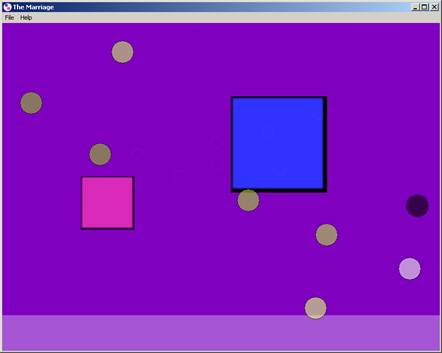
outside the gameplay (i.e., the backstory), is, in my view, problematic. Game designer and former Sony Online Entertainment employee Rod Humble has helped to begin what I believe will lead to a revolution of "meaningful" gameplay - gameplay that is communicative in the way that books and film are communicative. He views gameplay itself as a kind of paintbrush, and I feel he has used it effectively in his small game, The Marriage, in which he attempts conveys the feeling he gets from being married. The game is, however, abstract, and while this abstraction lessens the dramatic effect, I believe that a game designer could effectively remove the abstraction simply by doing what artists do best: representing life.
Attempting to explain every facet of the game's analogy to marriage is beyon
d the scope of this blog entry, but I will sum it up briefly: You essentially play the "agent of Love," as Humble puts it in his explanation of the game, trying to keep the couple engrossed in their marriage. The male counterpart is represented by the blue square, the female, the pink. Their individual sizes update throughout the game representing each respective spouse's "dominance," in the marriage, while their translucency indicates their individual level of engagement in the marriage. The player can "mouse over" the squares to cause them to come together and "kiss," after which they bounce off and go their separate ways, until the player causes them to begin moving toward each other again. Circles signify events that affect the marriage from the outside. They fly around the screen, seemingly at random.

While I am unclear about what every individual item
in the metaphor actually means, one thing seems clear: It is a game about balance. For example, when the couple "kisses," the masculine square shrinks in size, while the female counterpart grows. Indeed, it is clear that Humble is commenting on the differing, often conflicting, requirements a husband and wife in marriage. Similarly, colliding with or "mousing over" each circle effects each spouse differently. The player must draw upon these resources to keep the marriage alive, balancing each individual's levels dominance and engagement. This feeling of balance comes purely from the gameplay.

Rod Humble was able to create this game by taking intangible phenomena, such as marital dominance and contentment, and making them part of the mechanics of a game. He quantifies these emotions and puts them in the context of rules. He made them visual - though, abstractly visual - so that the player can literally see and respond to what is happening. Thus, I feel that Humble succeeds in the ambition he states in his explanation, which is to u
se "...game rules to explain something invisible but real." Humble has essentially "painted" with gameplay.

While Humble views his game as art, he recognizes one immediate failure of the game as a communicative device: It requires explanation. "I wanted a game that the graphics and other elements took second stage," writes Humble, reminding us that Chess is engaging, "whether playing with stones or diamond encrusted ivory sculpted pieces. One should not assume the game is incomplete because of its graphical simplicity...." Essentially, Humble sets out to create art with gameplay alone.

And yet, Humble admits he "cheated a little here by using colour symbolism similar to painting." Even at a more basic level, the game fails to work without some sort of visual representation - whether it be squares or circles. As unintelligible as the game is without the explanation, it still is dependent on some sort of visual representation - color, motion, etc. - to create meaning. What would happen if we truly reduced the game down to just its mechanics? I would imagine this would look like a table of numbers, moving up and down, keeping track of each object's position in space, size, color, etc. Even then, we are using numbers and charts to represent the gameplay!

It would seem that gameplay requires representation to be intelligible. It by itself cannot be used to create art - it is only a fundamental element of game design. Meaning comes from combining rules with a "dramatic" element - the element that provides context: characters, goals, etc. Thus, by replacing the abstraction of squares and circles with natural-looking characters and situations, The Marriage would not only become intelligible, but also more emotionally engaging. No longer would the player be dealing with squares and circles, but with people.

So, how do we make the conversion from abstraction to naturalism? I believe this can largely be done by simply looking at life and other media, such as film. Instead of using a change in size to indicate marital dominance, the designer must ask himself, how might this be indicated in real life? For example, as a wife gains dominance, she may take on a more demanding tone of voice, become more talkative, etc. Instead of visual translucency, marital satisfaction might be indicated by indifferent facial expressions, or a reduction in the tendency to hug or kiss. The designer has control over the inputs and outputs of the game, and can choose to make them abstract or naturalistic.

Like the gameplay in "The Marriage," game design is a balancing act. Too much focus on rules, and the game is unintelligible; too much on the "dramatic" element, and we miss out on that unique ability to explain difficult concepts to us through choice, consequence, and performance. I believe Rod Humble is tapping into something that could help to turn games into a medium of choice for artists seeking to convey a message, so long as we learn how to harness that power through naturalistic representation.

A screenshot from the tech demo for Heavy Rain,
a game which garnered attention at the Electronic Entertainment Expo
in 2006, due to its lifelike, emotive animation.