 Over the last fifteen years, we have seen the average video game grow longer and become more narrative-driven than ever. If massively-successful, story-oriented franchises like Final Fantasy, Metal Gear Solid, Grand Theft Auto, and Halo are any indication, gamers respond to emotion. They respond to characters, story arcs, and most of all, purpose. They want to know who they are fighting, and why. Knowing this seems to give their bullets meaning.
 And yet, the fact that the meaning seems to come from outside the gameplay (i.e., the backstory), is, in my view, problematic. Game designer and former Sony Online Entertainment employee Rod Humble has helped to begin what I believe will lead to a revolution of "meaningful" gameplay - gameplay that is communicative in the way that books and film are communicative. He views gameplay itself as a kind of paintbrush, and I feel he has used it effectively in his small game, The Marriage, in which he attempts conveys the feeling he gets from being married. The game is, however, abstract, and while this abstraction lessens the dramatic effect, I believe that a game designer could effectively remove the abstraction simply by doing what artists do best: representing life.
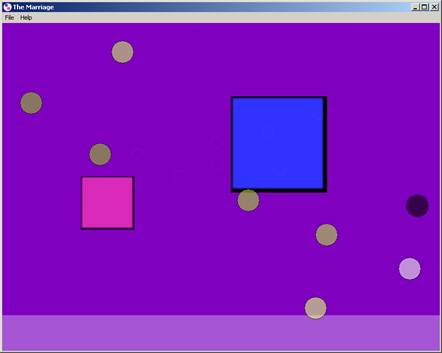
Attempting to explain every facet of the game's analogy to marriage is beyond the scope of this blog entry, but I will sum it up briefly: You essentially play the "agent of Love," as Humble puts it in his explanation of the game, trying to keep the couple engrossed in their marriage. The male counterpart is represented by the blue square, the female, the pink. Their individual sizes update throughout the game representing each respective spouse's "dominance," in the marriage, while their translucency indicates their individual level of engagement in the marriage. The player can "mouse over" the squares to cause them to come together and "kiss," after which they bounce off and go their separate ways, until the player causes them to begin moving toward each other again. Circles signify events that affect the marriage from the outside. They fly around the screen, seemingly at random.
While I am unclear about what every individual item in the metaphor actually means, one thing seems clear: It is a game about balance. For example, when the couple "kisses," the masculine square shrinks in size, while the female counterpart grows. Indeed, it is clear that Humble is commenting on the differing, often conflicting, requirements a husband and wife in marriage. Similarly, colliding with or "mousing over" each circle effects each spouse differently. The player must draw upon these resources to keep the marriage alive, balancing each individual's levels dominance and engagement. This feeling of balance comes purely from the gameplay.
Rod Humble was able to create this game by taking intangible phenomena, such as marital dominance and contentment, and making them part of the mechanics of a game. He quantifies these emotions and puts them in the context of rules. He made them visual - though, abstractly visual - so that the player can literally see and respond to what is happening. Thus, I feel that Humble succeeds in the ambition he states in his explanation, which is to use "...game rules to explain something invisible but real." Humble has essentially "painted" with gameplay.
While Humble views his game as art, he recognizes one immediate failure of the game as a communicative device: It requires explanation. "I wanted a game that the graphics and other elements took second stage," writes Humble, reminding us that Chess is engaging, "whether playing with stones or diamond encrusted ivory sculpted pieces. One should not assume the game is incomplete because of its graphical simplicity...." Essentially, Humble sets out to create art with gameplay alone.
And yet, Humble admits he "cheated a little here by using colour symbolism similar to painting." Even at a more basic level, the game fails to work without some sort of visual representation - whether it be squares or circles. As unintelligible as the game is without the explanation, it still is dependent on some sort of visual representation - color, motion, etc. - to create meaning. What would happen if we truly reduced the game down to just its mechanics? I would imagine this would look like a table of numbers, moving up and down, keeping track of each object's position in space, size, color, etc. Even then, we are using numbers and charts to represent the gameplay!
It would seem that gameplay requires representation to be intelligible. It by itself cannot be used to create art - it is only a fundamental element of game design. Meaning comes from combining rules with a "dramatic" element - the element that provides context: characters, goals, etc. Thus, by replacing the abstraction of squares and circles with natural-looking characters and situations, The Marriage would not only become intelligible, but also more emotionally engaging. No longer would the player be dealing with squares and circles, but with people.
So, how do we make the conversion from abstraction to naturalism? I believe this can largely be done by simply looking at life and other media, such as film. Instead of using a change in size to indicate marital dominance, the designer must ask himself, how might this be indicated in real life? For example, as a wife gains dominance, she may take on a more demanding tone of voice, become more talkative, etc. Instead of visual translucency, marital satisfaction might be indicated by indifferent facial expressions, or a reduction in the tendency to hug or kiss. The designer has control over the inputs and outputs of the game, and can choose to make them abstract or naturalistic.
Like the gameplay in "The Marriage," game design is a balancing act. Too much focus on rules, and the game is unintelligible; too much on the "dramatic" element, and we miss out on that unique ability to explain difficult concepts to us through choice, consequence, and performance. I believe Rod Humble is tapping into something that could help to turn games into a medium of choice for artists seeking to convey a message, so long as we learn how to harness that power through naturalistic representation.
 A screenshot from the tech demo for Heavy Rain,
a game which garnered attention at the Electronic Entertainment Expo
in 2006, due to its lifelike, emotive animation.


A very unique look at story-telling in video games, art, and marriage. As an ex-PC gamer myself I must agree with many of your observations and highlight Half-Life as one of the few games (I much prefer Half-Life to Halo) to completely immerse me in the world. I think that the Half-Life series takes the idea of balance between game-play and story extremely seriously and it benefits from this.
ReplyDeleteI would also like to know your take on multi-player games such as Counter Strike, Call of Duty, and Company of Heroes, all of which are popular because of game-play rather than story. In COD 5 the Nazi Zombie mode is entirely game-play with almost no story, but it seems to be the most popular feature of the game.... Any thoughts?
As a fine artist I find emotion to be a powerful tool. I am glad you touch upon this in your blog. Hopefully, in the future, more games will touch upon the emotional aspect of human life, making a high paced shooter feel a little more human.
Yes, The Marriage is a brilliant piece. I was in awe of how accurate a representative game system can be. Sadly, though, I don't think it's just as easy as "removing" the abstraction, or putting a face on it, to make these games more relevant, realistic, and marketable. If The Marriage was realistic, we wouldn't actually SEE how these variables work; they'd be playing in the background, while we’re oblivious, trying to catch a glimpse at this complicated AI with no real idea as to how it works, or what the designer is saying. Humble is speaking through the mechanics by giving us a top-down view on objects whose size, translucency, and position tell the story. Trying to discern these variables from a Heavy Rain-like look and feel, I think, would be futile.
ReplyDeleteNow, I hope I’m wrong. I hope that we can show these things with concise visuals, sound, and mechanics. There are a couple ways I can be wrong. First, people could be smarter than I think they are. Maybe these variables (and their relation to one another) wouldn’t be that hard to see if hidden by AI. Second, perhaps we would only need to make a few minor changes. It might be effective to just display all the variables in a simple HUD.
Nevertheless, I think us game designers have a lot of work to do before we get to actually selling games with themes this strong and clear. But we will arrive.
Everything I have learned about the art of interactive media leads me to believe that many of the principles of cinema can be effectively applied to it. You mention the balance of rules and dramatic elements as a key to game design. In the same way a screenplay is its own unique balancing act of character development and expository information, reality and drama, and other elements. Solving these problems is usually different for every project which is what makes each one interesting. I think it is safe to assume that the same applies to game design.
ReplyDeleteBryant mentioned that creating a naturalistic feel for the game “Marriage” would be ineffective. I can certainly see the reasoning behind this idea. Without the quantitative measurements associated with a game like “Marriage,” it seems that a gamer would not be able to gather meaning from the events of the game. In life, however, we are able to pick up on social cues and other information based on what we see and hear. In the early days of cinema “over-the-top” acting was considered the standard. I assume that at the time filmmakers did not believe the audience would understand the emotions of the film without the actors indicating their emotions to the audience. As time passed, filmmakers realized that the audience was able to pick up on these more subtle clues, and the films of today can almost be equated with documentaries. I believe that games can work in the same way, but it may take some time before gamers are willing to accept games with such subtlety.
I like Humble's idea of The Marriage, especially the concept of influences from outside. I think he has a negative view to a marriage because outside effects are the big fact in this game, maybe, so as his marriage. I think populality of games is related to sympathies which you can share with other people. For instance, you create a game which is awesome to you. People are not going to buy unless they feel the same enthusiasm you felt when you were making it.
ReplyDeleteI have recently read interviews of Final Fantasy's creater and Super Mario's creater in Japanese. They were talking about the period when they were making games for a nintendo. They were forced to make games at the time. They had no idea which game would be popular. These days, games are much more complicated. They have a stronger back ground, a philosophy, nice graophics, etc. Humble's concept of meaning of a game counld be a symbol of future generation of games.